


Implementation included
No project is the same as another. They have different scopes—industrial, infrastructure, civil construction—and require distinct control approaches. Therefore, RDOWEB was designed as a configurable solution that adapts to the operational reality of each project.
Configuring the initial setup
Many companies acquire software to issue electronic Daily Construction Reports aiming to automate an existing routine. Others expect to create an information-recording process through software installation. In both cases, it is essential to adhere to the particularities of each project for the investment to make sense.
In other words, the efficiency of an electronic Daily Construction Report is directly proportional to its ability to accurately reflect the reality of the project. If it faithfully represents the project's reality, it enables decision-making. This helps keep the project on schedule, maintain productivity at expected levels, and assist in controlling associated costs.
RDOWEB adopts a modular and parameterizable cloud architecture, based on a rigorous implementation engineering process that ensures regulatory, technical, and contractual adherence to each client's operating model.
Below is the implementation roadmap for projects using RDOWEB.
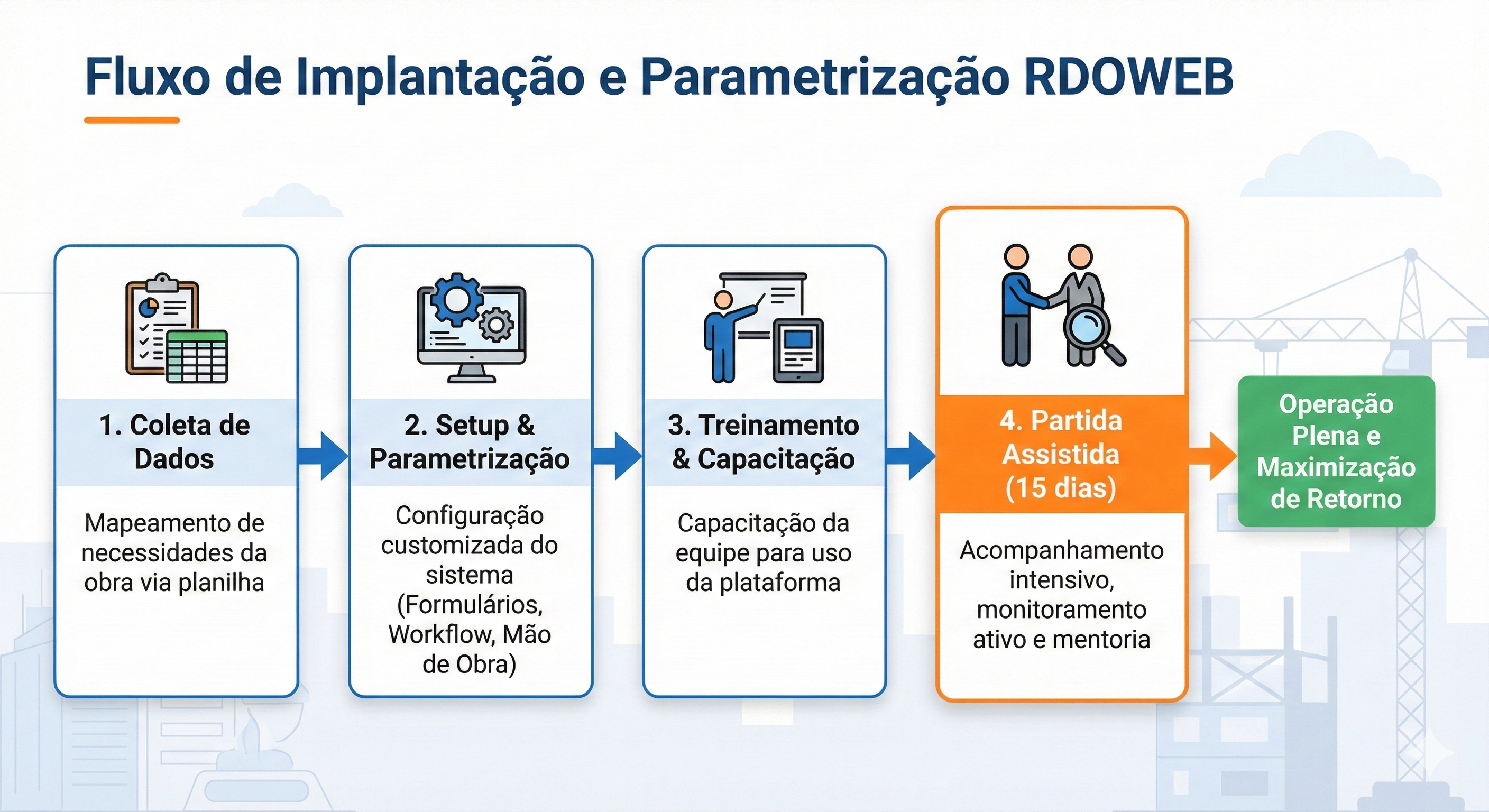
1 Diagnosis and data collection phase: The implementation process is initiated individually for each project added to the platform. This stage is based on a data collection matrix filled out by the client, which serves as the starting point for the environment setup. Through this diagnosis, the RDOWEB specialists identify the project’s critical variables, such as:
- Workforce Allocation Criteria: Configuration between Name-Based tracking, focused on individual man‑hour entries and employee traceability, or control by Role Histogram tracking, aimed at headcount accounting by professional category and qualified presence. In both cases, turnstiles or time clocks can be connected to automate the process.
- Segmentation by Project Scope: Adjustment of forms to the specific needs of the project, such as Industrial (maintenance, shutdowns, productivity, deliveries, and schedule), Civil Construction (focused on services and resources used), or Infrastructure projects.
- Definition of Form Attributes: Establishment of mandatory and conditional fields, ensuring that the field data collection flow is optimized for the reality of the work front, avoiding both information scarcity and redundancy.
2 System Parameterization and Workflow Customization: After analyzing the data matrix, RDOWEB loads a project-specific setup. Unlike generic solutions, parameterization allows:
- Field Variables Management: Activation of specific modules such as rainfall measurement, with or without weather station integrations, working conditions, downtimes and interferences, safety incidents, and pre‑registration of resources and tasks.
- Hierarchical Approval Workflow: Structuring digital signature instances in accordance with Law 14.063 and Provisional Measure 2.200, defining authoring and inspection/validation profiles. This configuration ensures that data consolidation occurs only after the formal review process.
3 Assisted Go-Live and Performance Monitoring: To mitigate risks inherent to the process transition phase, RDOWEB implements Assisted Go-Live. This is an active monitoring process that takes place during the first 15 days of full project operation, acting as specialized Level 1 support and part of Customer Success.
- Data Entry Audit: The technical team monitors the integrity and consistency of the entered information, verifying whether the initial parameterization is being executed as planned.
- Advisory Intervention: When inconsistencies or underutilization of the tool are detected, project stakeholders are proactively summoned for technical alignment and recommendations for improvements.
- Refresher Training: Assisted Go‑Live complements the initial Training and Onboarding cycle. It addresses complex operational questions that arise only during actual usage of the platform, ensuring that the field team reaches the required proficiency in the shortest possible time.
4 Training Cycle and Return Maximization: Technical training is treated as a continuous and cumulative process. By combining formal training with active monitoring during the Assisted Go-Live phase, RDOWEB ensures that the platform is not merely a data repository, but a strategic management tool. The ultimate goal is to maximize the usefulness of data for measurements, contractual claims, and evidence-based decision-making supported by auditable records.
Technical Compliance
The data structure generated through this implementation process is designed to support internal and external audits, ensuring that the project's history becomes a solid and reliable knowledge base for the organization.
Support and Continuous Improvement
Take advantage of Assisted Go-Live and multichannel support to optimize the process:
- Refresher Training: Whenever there is a change in the inspection team, contact RDOWEB support to ensure the training included in the contract.
- Parameter Adjustments: If the project model undergoes scope changes, request a review of the forms to keep the platform aligned with the new reality.

Find out more
Clients



































































Technical Presentation
REQUEST DEMO
Fill in the form and one of our specialists will contact you to schedule a meeting the best day and time.